%20Gradient%20%E2%80%94%20light%20to%20dark.png)
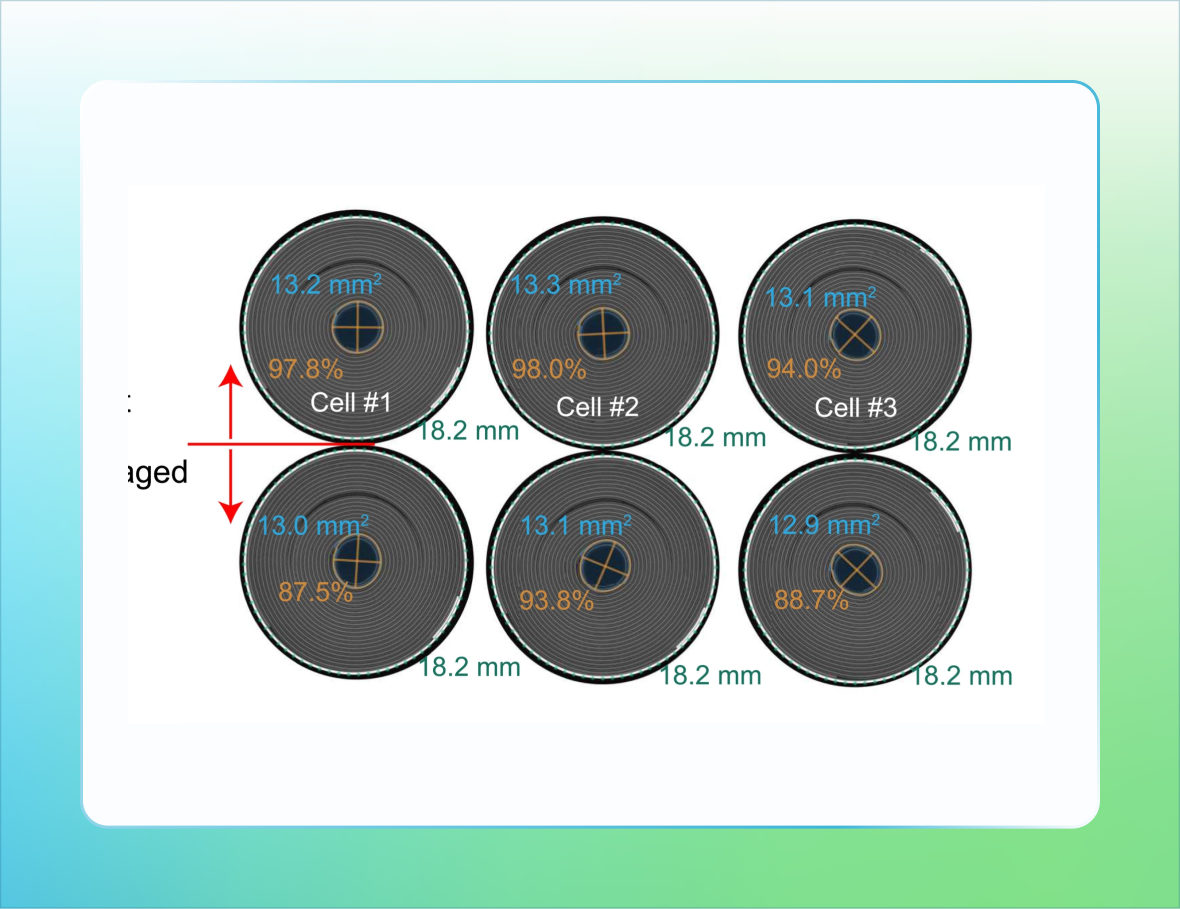
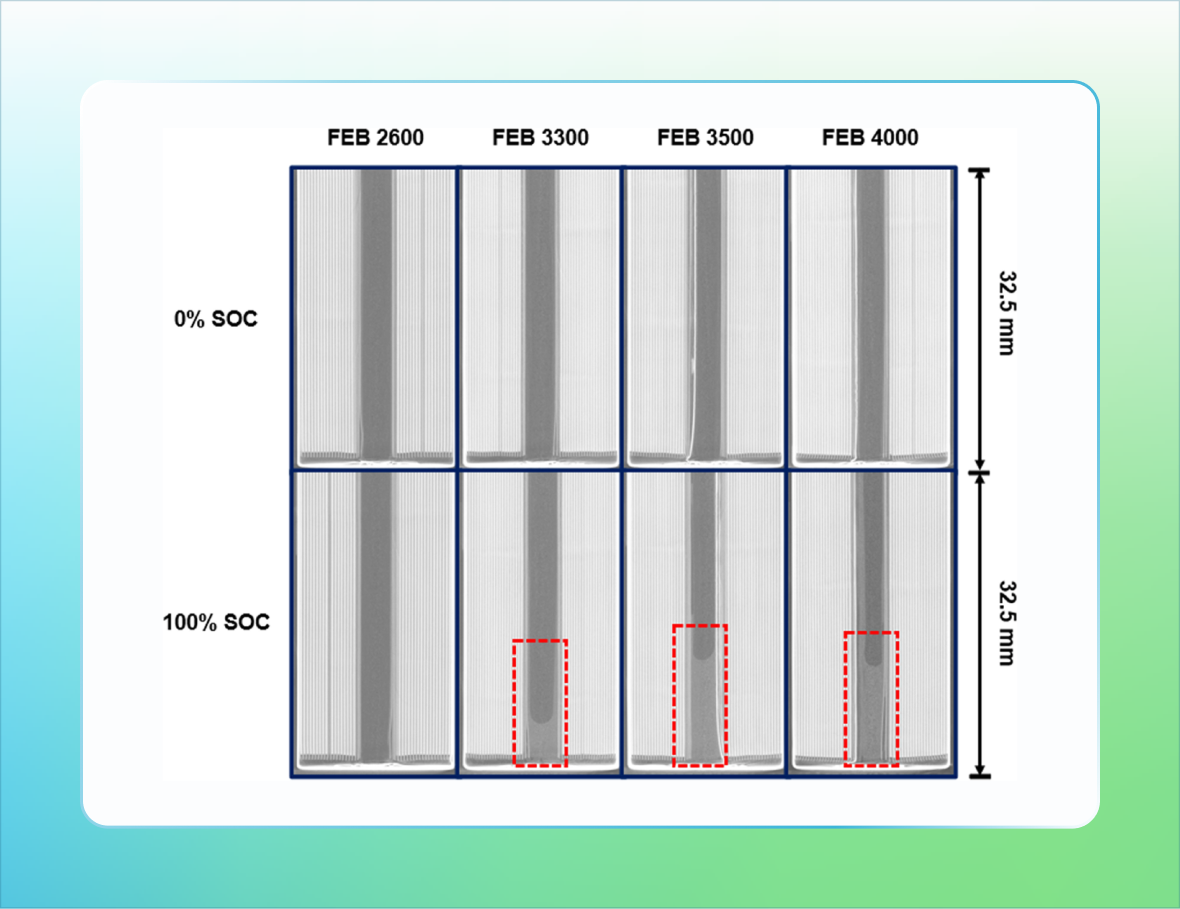
When a lithium-ion cell charges and discharges, the electrodes expand and contract as ions move in and out of their host materials. These changes are small (1-10%) but encode important details about both initial cell construction and expected cell aging. While this “breathing” effect is well understood on the particle and electrode levels, few studies have attempted to comprehensively quantify this effect on the full-cell level.
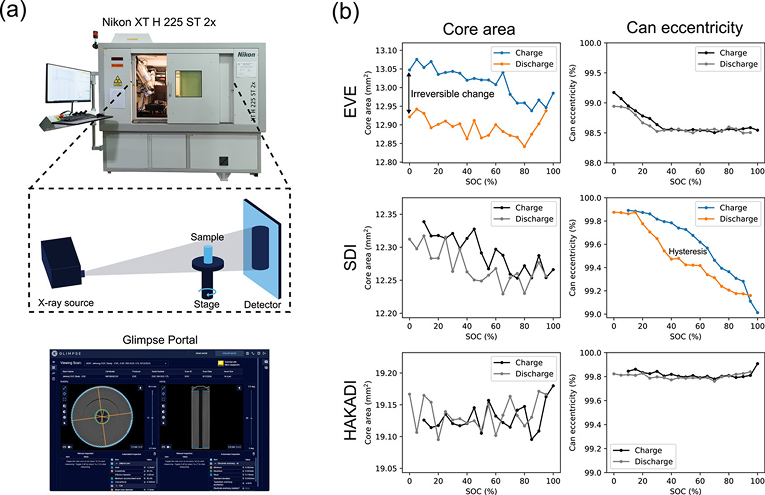
Summary of some key geometric trends observed in various cylindrical cells as a function of state-of-charge. Reproduced from Figure 1 of Cogswell et al.
We aimed to fill this gap with our latest publication, led by Daniel Cogswell (Cogswell Scientific) and our former summer intern Jinhong Min. The paper, entitled “Geometric Changes in Cylindrical Batteries as a Function of State of Charge,” was published in the Journal of The Electrochemical Society and can be read here.
Using high-resolution, high-throughput CT and Glimpse’s suite of automated computer vision algorithms, we measured how commercial lithium-ion and sodium-ion cells change shape as a function of state of charge (SOC). We sampled 5% increments of SOC to ensure we could capture the subtle trends we were expecting. The results revealed subtle yet clear, cell-specific signatures: some cells showed a core area change with both reversible and irreversible components, others exhibited hysteresis in can deformation, and the sodium-ion cells we tested showed no significant geometric changes at all! We present various visualizations of this rich dataset to visualize these geometric changes as a function of both SOC and height along the cell.
Some cells showed a core area change with both reversible and irreversible components, others exhibited hysteresis in can deformation, and the sodium-ion cells we tested showed no significant geometric changes at all.
While these SOC trends at beginning of life are useful in their own right to assess initial swelling behavior, particularly for cell designs at high risk of mechanical failure (e.g., cells with high silicon content in the anode), we suspect (but did not validate) that these trends may correlate with irreversible mechanical deformation during aging. In other words, how a cell breathes at beginning of life may help predict the extent of swelling later-in-life, shortening testing times for challenging mechanical failure modes.
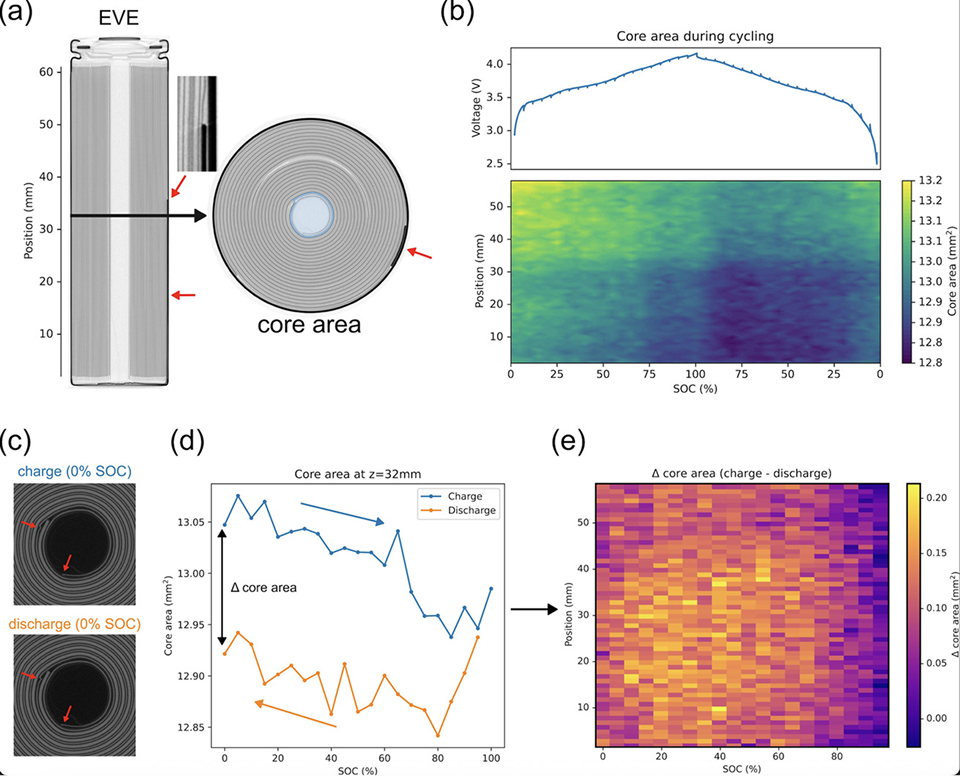
Core area of cylindrical lithium-ion cells as a function of state of charge, revealing a reversible “breathing” change alongside a smaller irreversible change over the first cycle. Reproduced from Figure 2 of Cogswell et al.
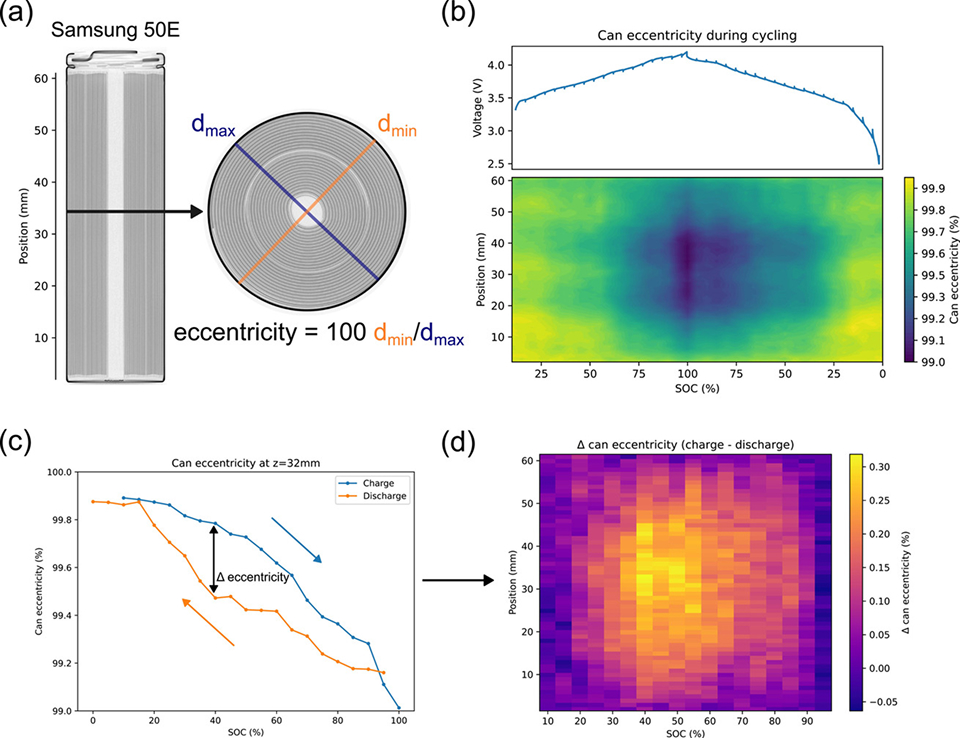
Can eccentricity of cylindrical lithium-ion cells as a function of state of charge, showing clear hysteresis between charge and discharge. Reproduced from Figure 3 of Cogswell et al.
This work demonstrates CT’s power as a quasi-in-situ imaging technique, sensitive enough to capture subtle geometric changes that may provide early indications of late-in-life behavior. Contact us to leverage high-throughput CT scanning for your own cell characterization and development needs.