%20Gradient%20%E2%80%94%20light%20to%20dark.png)
Impact testing is an underrated but crucial element of battery cell testing. Cells experience impact when phones are dropped, when e-scooters hit a speed bump, and even when satellites are struck by space debris. Big impacts are often obviously bad, but how do more moderate impacts affect cell mechanical performance?
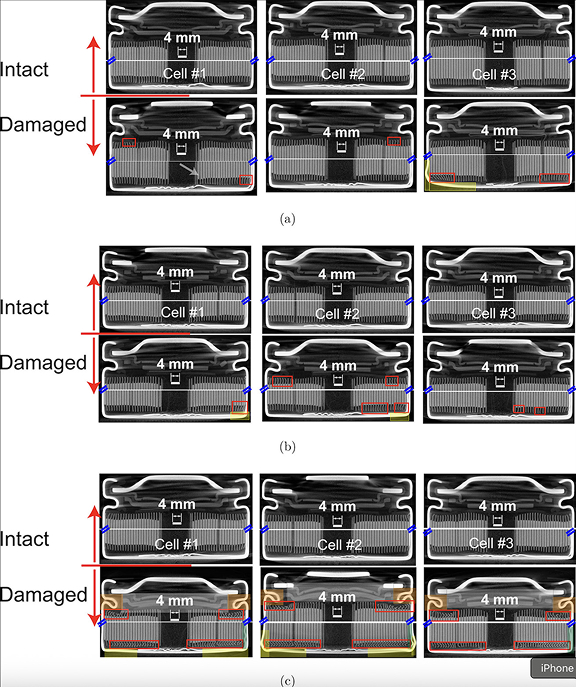
CT images revealing damage to crimps and overhangs after various types of impact testing. Reproduced from Figure 3 of Kazem-Ghamsari et al.
Our most recent paper, entitled “Visualization and Detection of Internal Damage Caused by External Mechanical Loads in Cylindrical Li-Ion Batteries” and published in the Journal of the Electrochemical Society, set out to understand exactly this question. You can read the paper here. In this work, coauthored with the Juner Zhu lab at Northeastern University, we used CT scanning to quantify structural changes to cells before and after impact tests. Even when electrochemical signals provide ambiguous results, CT could directly visualize and quantify damage to crimps, overhangs, and cores. To quote the conclusion:
CT imaging directly revealed damage to both active (electrodes) and inactive (current collectors, tabs, and overhangs) components, highlighting critical structural changes invisible to cycling data alone that arise even with moderate mechanical loads.
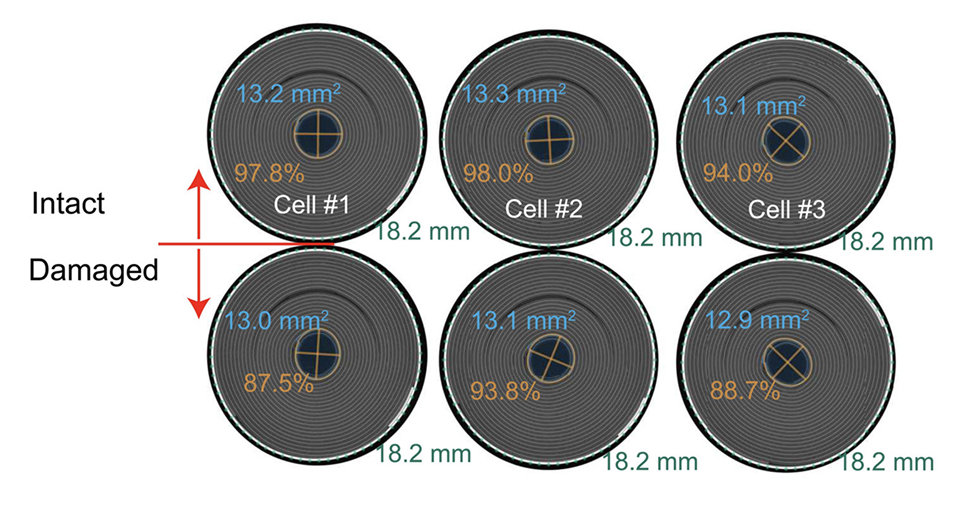
CT images and Glimpse’s automated inspection algorithms showing a decrease in core circularity after various types of impact testing. Adapted from Figure 4 of Kazem-Ghamsari et al.
Just like using X-ray imaging to diagnose a bone fracture, CT can detect latent internal damage in cells long before it manifests in measurable electrochemical degradation. Contact us to leverage high-throughput CT scanning for impact testing.