%20Gradient%20%E2%80%94%20light%20to%20dark.png)
Glimpse’s work with the inimitable Jeff Dahn, as well as colleagues from Tesla, was just published! The publication is entitled “Electrolyte Motion Induced Salt Inhomogeneity in Si-Containing Cylindrical Cells – A Case Study” and was published in the Journal of The Electrochemical Society. You can read the paper here.
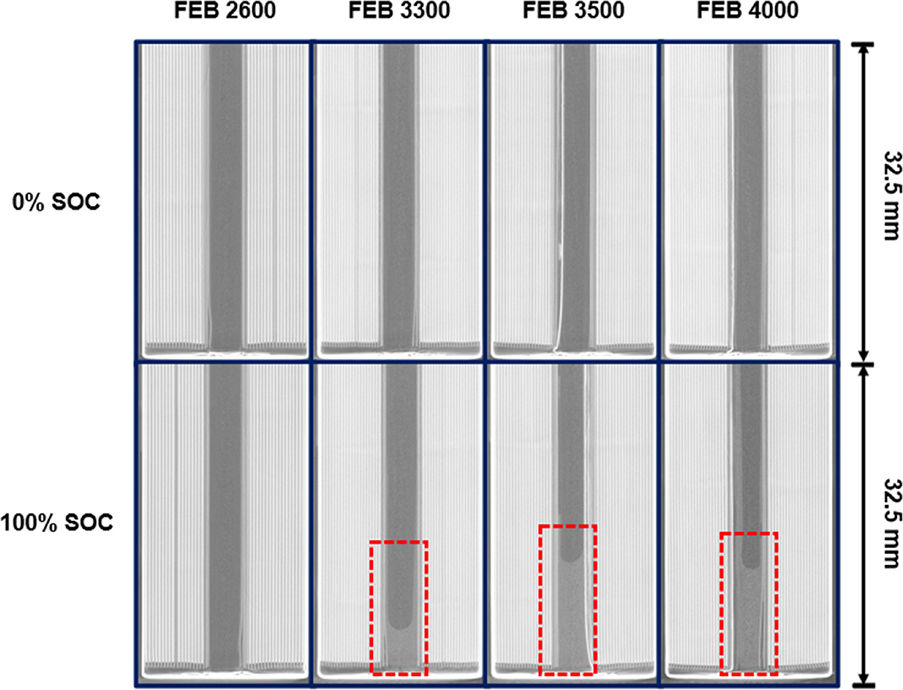
CT cross-sections of an 18650 cell revealing electrolyte pooled in the jellyroll core. Higher silicon content, and higher state-of-charge (SOC), drives a higher volume of electrolyte into the core. Reproduced from Figure 8 of Donais et al.
The main goal of this paper was to understand how anode silicon content affects a recently identified failure mechanism called electrolyte motion induced salt inhomogeneity (EMSI). In cylindrical cells, repeated cycling causes the electrodes to expand and contract, squeezing electrolyte out of the jellyroll and into the core. Over many cycles, salt concentration gradients develop across the cell height, degrading rate capability and potentially causing lithium plating and cell failure.
The study systematically varied silicon oxide (SiOx) content in anodes from 0 to 15% by weight and tracked the consequences in 18650 cells. The results were clear: higher silicon content drives more electrolyte pumping, faster resistance growth, and accelerated capacity loss. CT imaging played a key role in this work: Glimpse scanned cells at different states of charge to directly visualize the electrolyte pooled in the jellyroll core, validating the electrolyte displacement measurements obtained via rotational inertia measurement (RIM). The CT and RIM results correlated closely, providing additional confirmation that the excess electrolyte observed in the core was real and quantifiable.
The results were clear: higher silicon content drives more electrolyte pumping, faster resistance growth, and accelerated capacity loss.
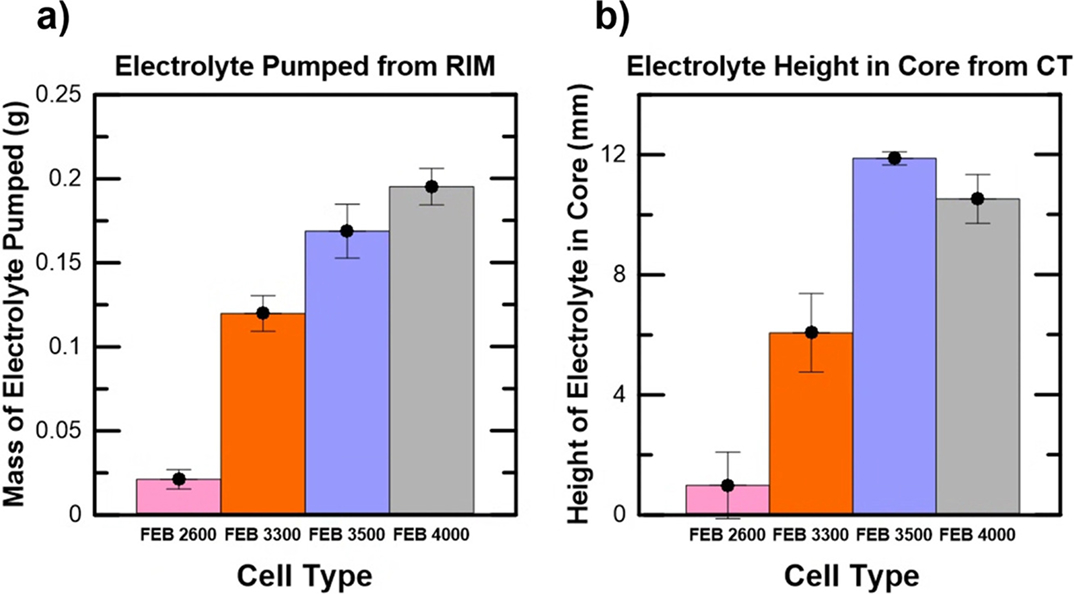
Comparison of electrolyte pumping as a function of silicon content (“cell type”), as quantified by CT vs. rotational inertia measurements (RIM). Reproduced from Figure 9 of Donais et al.
We’re honored to have worked with Prof. Dahn and his research group to study this important cell failure mode. Glimpse’s high-throughput CT scanning capabilities with high image quality enables fundamental studies into battery failure; contact us to leverage high-throughput CT scanning for your own cell characterization and failure analysis needs.