%20Gradient%20%E2%80%94%20light%20to%20dark.png)
As prismatic cells age, they swell. Gas generated by side reactions builds up inside the cell, causing the casing to bulge — which is why prismatic cells are often held under external pressure when assembled into a pack. But what is that swelling actually doing to the jellyroll, and does constraining the cell meaningfully change how the jellyroll deforms over life?
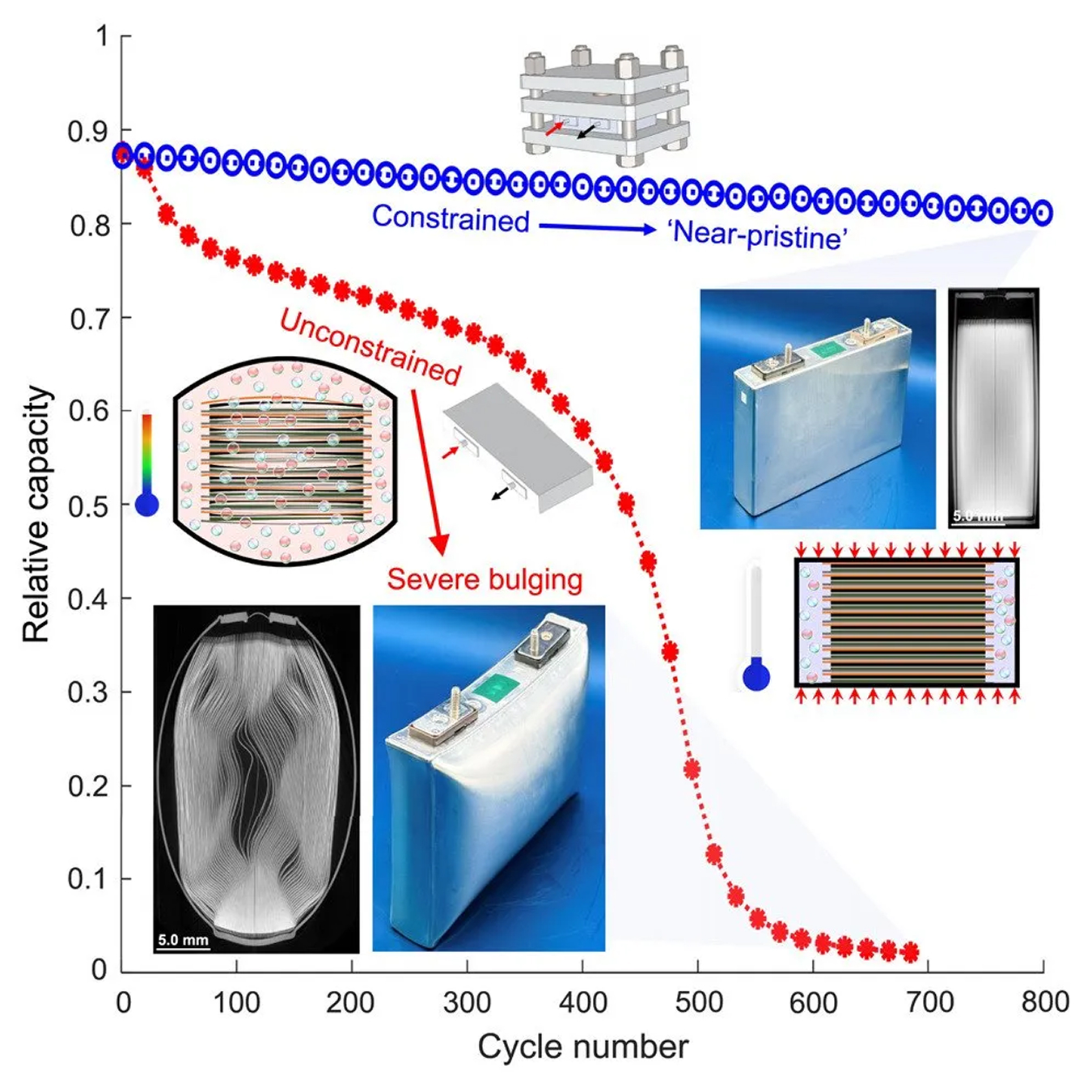
CT scans of prismatic cells aged with and without mechanical constraints. Reproduced from the graphical abstract of Ihuaenyi et al.
These questions motivated Glimpse’s work with Juner Zhu’s lab at Northeastern University, just published in Cell Reports Physical Science. The paper, entitled “Lifetime extension of aged Li-ion prismatic batteries via mechanical constraints,” can be read here.
The results are striking. Cells cycled under mechanical constraint showed minimal capacity loss, while the same cells cycled without any constraint suffered catastrophic capacity loss within 500 cycles. The unconstrained cells also bulged visibly, implying significant gas generation (the lead author called these “pufferfish” cells). But the location of that gas was ambiguous: did it compromise the jellyroll’s structural integrity, or did the jellyroll stay intact?
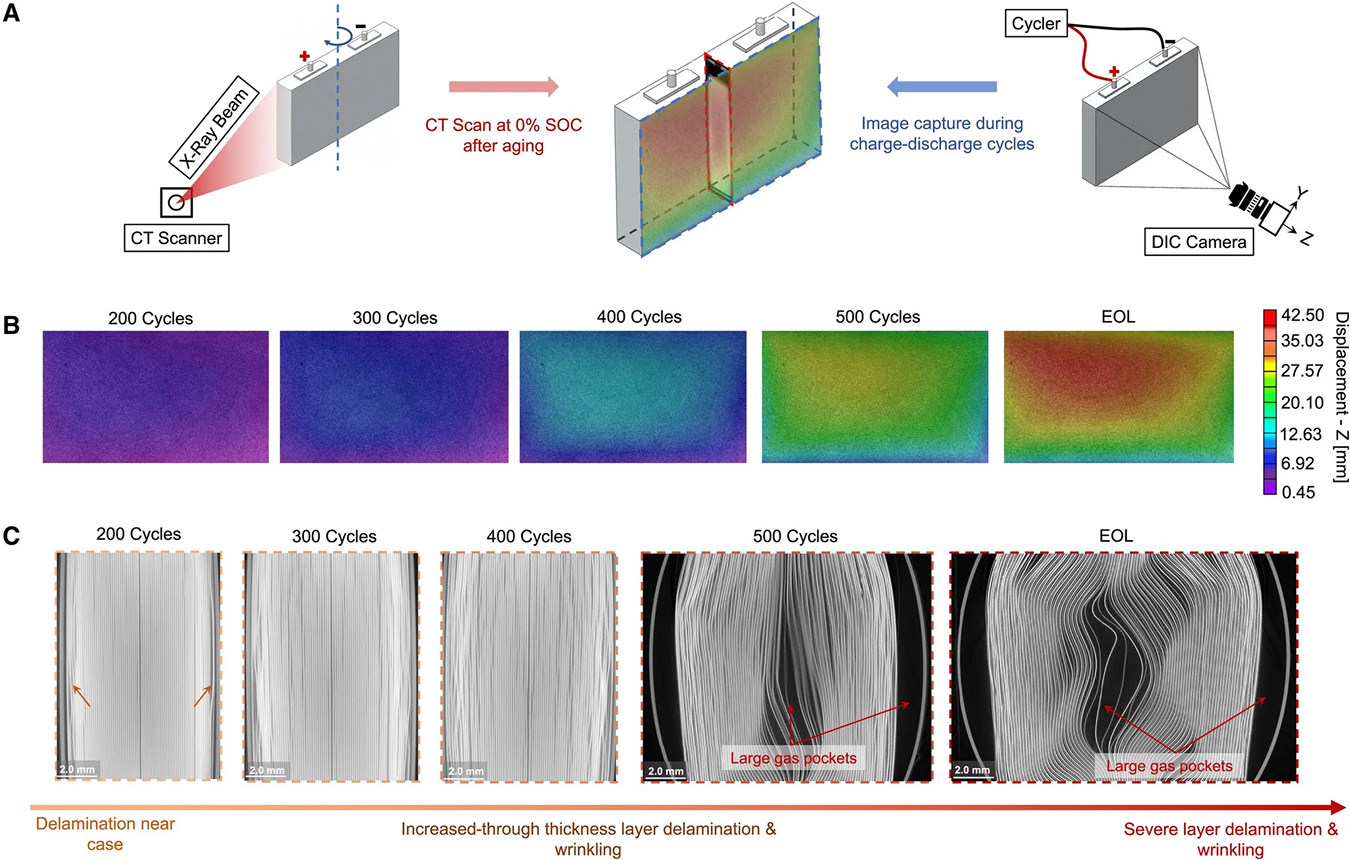
CT scans of a prismatic cell without mechanical constraints obtained throughout a cycling test. Note the severe deformation of the jellyroll and casing that occurs over the cell’s lifetime. Reproduced from Figure 2 of Ihuaenyi et al.
CT scanning the cells periodically over life revealed the answer. The jellyroll of the unconstrained cell began deforming as early as 200 cycles, then massively deformed with further cycling. Critically, the “knee” in the capacity-versus-cycle plot from 300 to 500 cycles tracks directly with the onset of major deformation visible in CT, cleanly linking the electrochemical failure to a mechanical root cause.
CT scanning provides invaluable insights into cell performance, reliability, and lifetime. Contact us to leverage high-throughput, high-quality CT scanning for your own cell development and testing needs.