%20Gradient%20%E2%80%94%20light%20to%20dark-p-2000.png)

The limits of electrochemistry for identifying latent battery quality issues
Whether you’re making cells or buying cells, you’re likely aware that tiny battery defects can lead to major safety and reliability issues. In fact, battery defects have been responsible for billion-dollar recalls in applications ranging from smartphones and laptops to electric vehicles.
Unfortunately, a slew of different defects can cause cell failure, particularly open-circuit and short-circuit failure. Figure 1 below contains illustrations of some common battery defects.
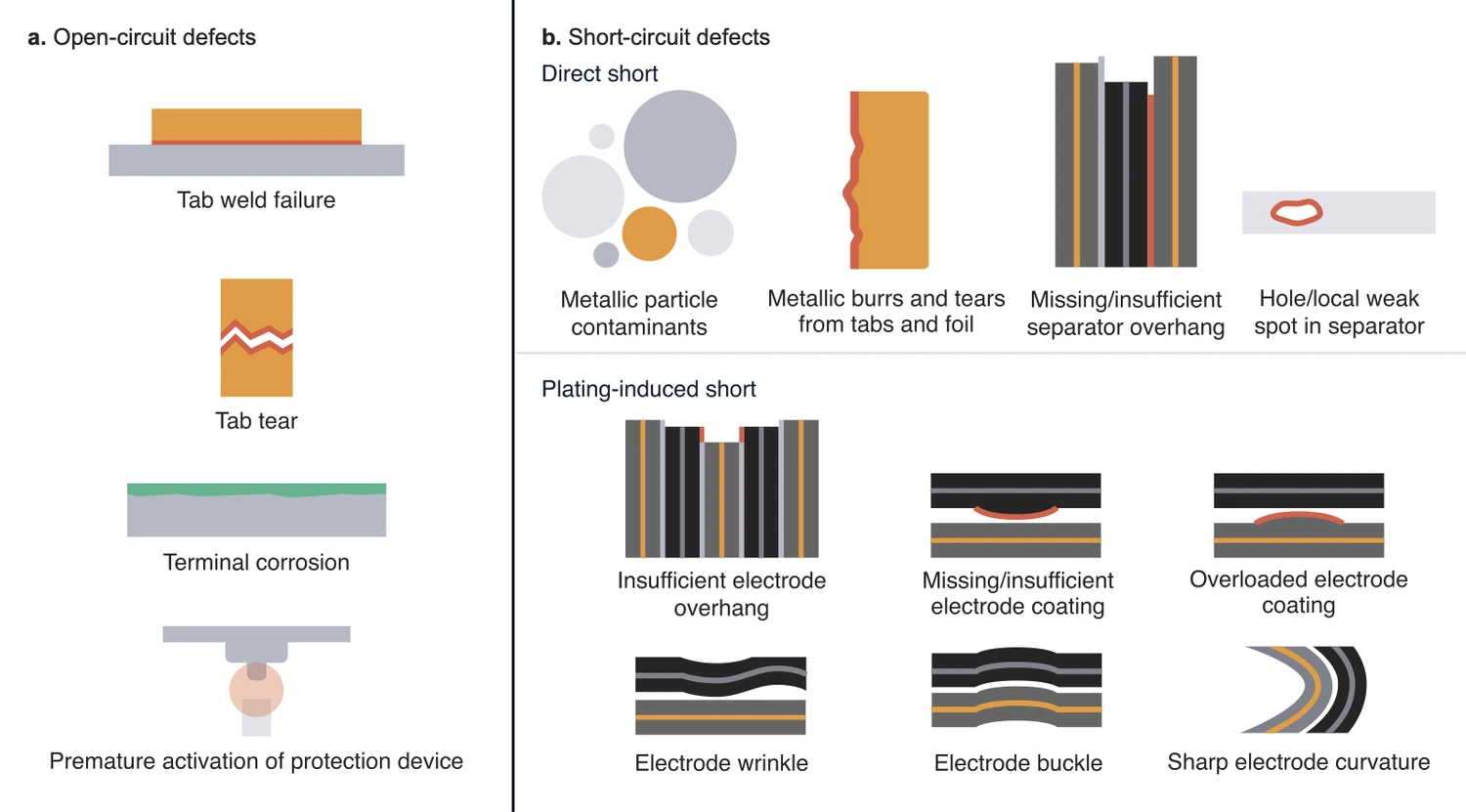
These defects are often tiny but dangerous, even deadly. Obviously, battery engineers must ensure that these defects never make it to the field (or even to lab tests). The question is: how do we detect if these defects are present in cells?
If you’re like most battery engineers, your first thought is likely to turn to electrochemical characterization. After all, batteries are electrochemical devices; electrochemical techniques are among the most powerful and direct ways to probe battery behavior, including cycle life and calendar life. Indeed, tests that measure the open-circuit voltage decay (“OCV decay”) are often used to detect internal shorting during battery production. Unfortunately, defect detection is one task where electrochemical characterization has some major blind spots.
Let’s take a look at two examples. First, imagine we have a metallic particle contaminant on the surface of an electrode. We can visualize the progression of this defect with respect to time as shown in Figure 2.
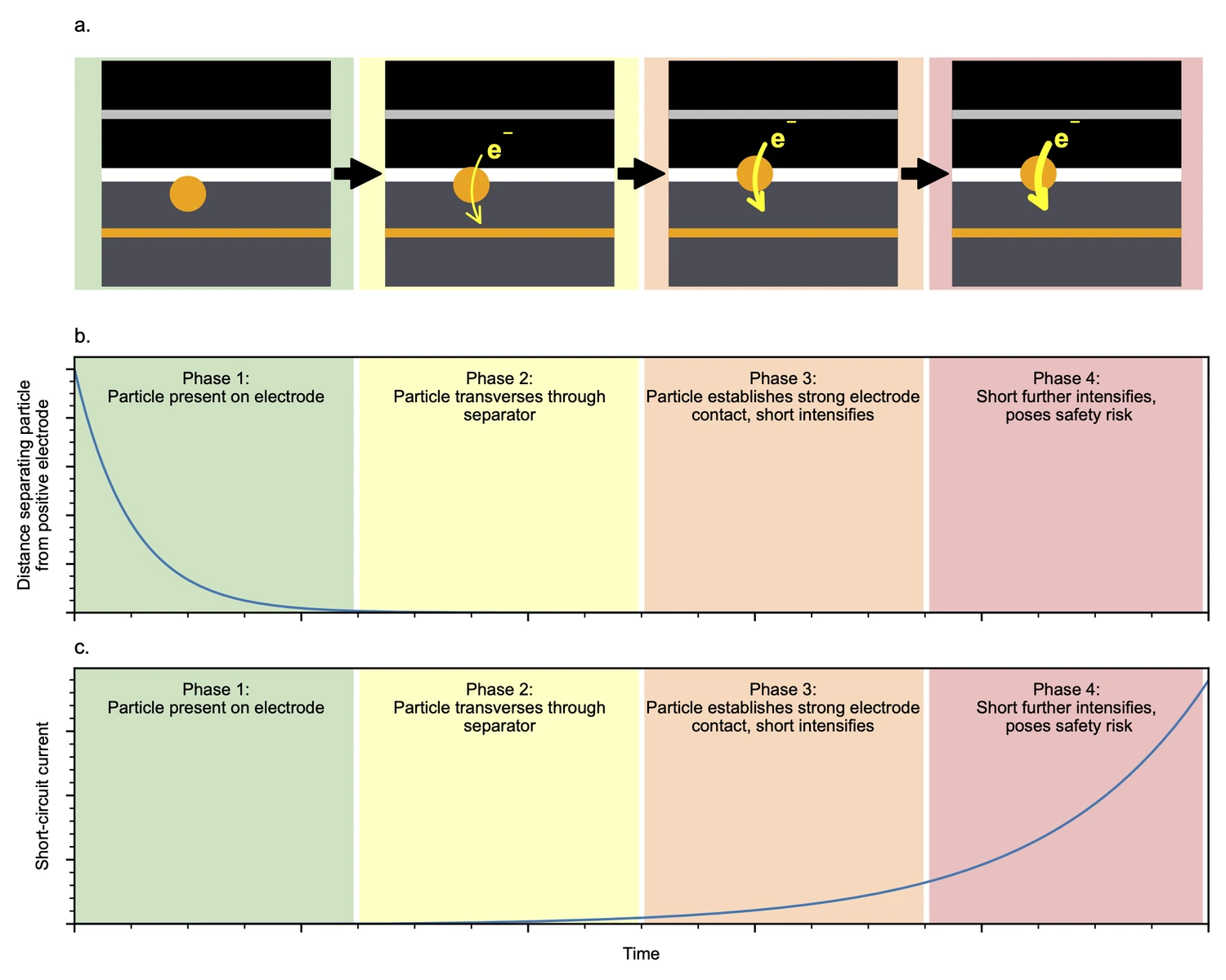
Let’s walk through this figure step-by-step:
- Phase 1. A particle is present but has not yet caused a short. Thus, this latent defect does not yet have an electrochemical signature.
- Phase 2. The particle has now contacted both electrodes. A very weak short has formed, but because this issue is localized to a tiny portion of the electrochemically active part of the cell, its impact on the health and electrochemical behavior of the battery is negligible and won't be measurable.
- Phase 3. The particle has developed stronger contact (lower interfacial resistance) with both electrodes. The short is now strong enough to measurably impact battery behavior.
- Phase 4. The short is strong enough to develop into a local current hotspot and induce thermal runaway.
Only in Phase 3—right before a safety event were to occur, probably in the field—-would this short have grown large enough such that electrochemical techniques could catch this issue. The problem is that barring the most severe issues, battery defects will still be in Phase 1 or Phase 2 when the cells leave the factory (as the cells are still in their infancy). Thus, if your goal is to prevent soon-to-fail batteries from escaping your factory or entering your products, relying on electrochemical techniques to catch these issues would be a serious mistake. Neither anomaly detection during formation nor data-driven lifetime prediction are solutions: latent defects simply have no electrochemical signal until it’s too late.
Importantly, note that a small short often does not impact capacity and energy during a cycle life test. A small short may not appreciably impact the capacity (dis)charged in each cycle, but small shorts can still cause major pack imbalance issues and/or suddenly develop into safety events. Electrochemical short-circuit detection (both in lab testing and in a BMS) is a challenging topic in its own right, as the short-circuit current must be disentangled from depolarization and self-discharge due to side reactions.
A second example of a latent defect is lithium plating on the negative electrode due to a defective coating process, in which the negative electrode was locally underloaded. See Figure 3 for a simplified illustration:
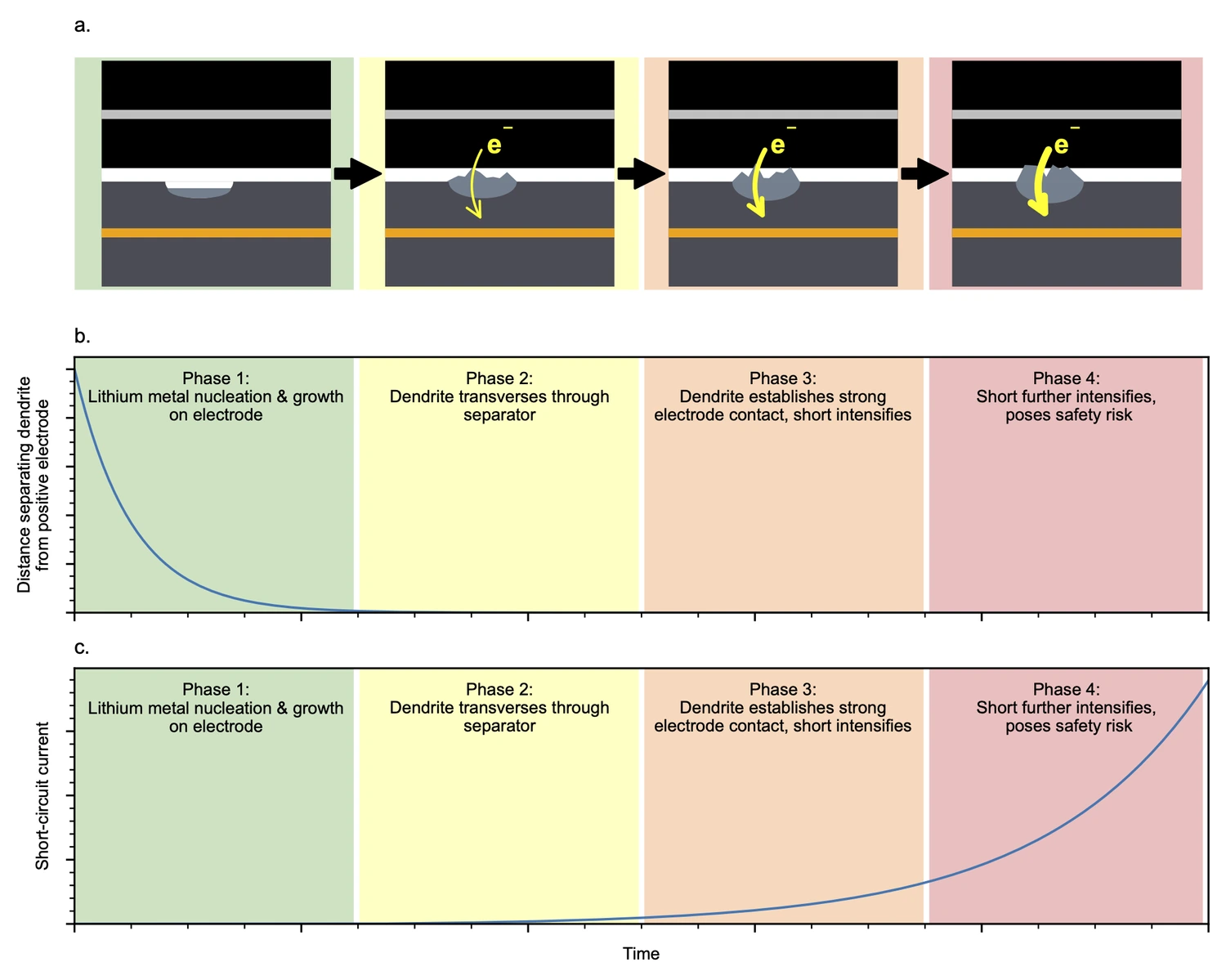
The situation presented here is nearly identical to the previous example, except now the short initiation will occur when the dendrite fully transverses the separator and contacts the positive electrode. Again, electrochemical testing will be ineffective; this defect is effectively impossible to capture until the short has sufficiently developed. While lithium plating is detectable via electrochemical characterization in principle, identifying minuscule amounts of lithium plating (i.e., in Phase 2) via these methods requires unrealistically ideal measurement conditions (such as very low rates, perfect temperature control, etc.) and is in fact an active area of research.
The bottom line? Electrochemistry can catch late-stage issues (Phase 3 & 4) but not early-stage issues (Phase 1 & 2). The solution is imaging—particularly CT scanning due to its unparalleled, high-resolution, 3D view into cells. Imaging techniques can readily detect many early-stage latent defects such as those depicted in Figure 1. In this sense, battery defects are somewhat analogous to cancerous tumors, where a localized issue such as a Stage I tumor will eventually threaten the health of the entire system. Of course, medical imaging is perhaps the most powerful tool at our disposal for cancer diagnosis; simpler time-series probes like heart rate monitoring will only reveal late-stage problems—exactly analogous to electrochemical techniques for battery defect diagnosis.
A final point: time. The OCV decay tests used in battery production today require rest times of days or even weeks to detect short circuits given variability in temperature, contact resistances, the cells themselves, and more. This test time is a major capex and opex bottleneck in lithium-ion battery production, but cell manufacturers often use this method since the cells have already been placed in cycling fixtures for cell formation. The situation is even more difficult for cell buyers (OEMs), as no OEM can afford to inventory their cells for weeks while testing their quality. Thus, rapid quality control tests such as high-throughput CT are essential for both outgoing and incoming quality control of batteries but especially critical for incoming quality control.
Electrochemical methods will always be indispensable for battery characterization, but you need CT—specifically high-throughput CT—to ensure the batteries you make or buy are free of latent defects. Contact Glimpse to learn more about our Scan on Demand and Glimpse Portal offerings.